How to Get Started
How to Get Started If we consider that the estimated time is the result of a mathematical equation, then before designing the equation we need to determine its constants and variables. We will achieve this by answering and applying the following.
The most important question «constantly» is this:
Am I healthy to take on a challenge like this?
We need to be sure of our health before embarking on a venture like this. Personally, I do blood tests before important goals for me or whenever I consider it necessary and upon the recommendation of a doctor, I have a heart ultrasound once (1) year.
Three more constants of the equation are the following:
To be in constant motion.
From the moment training begins, I will be in constant motion until the end of recovery, where active stretching will be performed.
- After warming up, to prepare the muscles for the main workout, I will perform two sets of running drills and strides
- The breaks between high-intensity runs in interval training will be slow jogging, not statically.
I never push my body to complete exhaustion.
At the end of main trainings, fatigue should occur, but in no case complete exhaustion. It is equally important that the body recovers on the days in between in order to properly perform the main trainings that follows.
I listen to my body.
If I don't feel well one day, it's better to skip a difficult workout and adjust my schedule. Be careful not to make this a rule! In this case, I need to reevaluate how many, which days of the week, and how much time per day I can dedicate to my training.
To identify the variables we need to answer the following questions.
How many times a week should I train?
Since this website is aimed at amateur runners, we will assume that two training sessions cannot be held in one day. Also, the minimum training sessions for proper preparation are three (3) in a week (assuming that the duration of a microcycle is one week) and the maximum is obviously seven (7).
How many hours can I dedicate to each training?
It is very important to know how many hours I can allocate for each training so that I can plan it properly and take advantage of all the time available, without skipping important parts of it, for example recovery.
If I can train seven (7) days a week, when will I rest?
I believe that abstinence is not necessary when our training plan can consist of seven (7) days a week, except for some exceptions such as perhaps the day before the race or if our day is very burdened by daily obligations or if we are very tired or sick, etc. Our recovery can be done with recovery running. This results in, in addition to the recovery of the body, the addition of easy kilometers to the weekly total of kilometers. In case the training plan includes fewer training sessions than seven per week, then I arrange so that the days that I will not have training coincide with recovery days, so that I do not miss the important training sessions.
Is it acceptable to perform important trainings on consecutive days?
No, it is not acceptable.
- Between an interval training and a tempo training or fartlak training and vice versa, there should be at least one (1) day of moderate intensity training.
- Between an interval training or fartlek training or tempo training and a long duration training, there should be one (1) day of moderate intensity training, if not possible two (2).
- Between a long run training and an interval training or fartlek training, there should be one (1) day of moderate intensity training.
Where will I do the trainings?
It is important, before we begin preparation, to decide on the areas in which we will perform the trainings.
This is a factor of two (2) things
- First, the location should be convenient so that we don't waste time traveling to the training area.
- Secondly, it must meet the requirements depending on the type of training.
- Long run, tempo run, interval training: Circular asphalt or dirt route of 4 – 7 kilometers without major elevation changes. Circular route to ensure that I don't carry my nutrition on me.
- Long run training with uphills and downhills: Circular safety or spatial route of 4 – 7 kilometers with elevation changes. Circular route to identify that I will not be carrying the power supply on me.
- Fartlek, interval training: In a stadium with a rubber mat or a dirt track or a circular track or a dirt track of 4 - 7 kilometers without major elevation changes.
- Uphill training: Asphalt uphill route of about 300 meters. If possible, the uphill should have a progressively increasing slope.
- Recovery running, free running: Grass or dirt track or stadium with rubber mat or dirt court.
- Gym
What are our aerobic and anaerobic threshold heart rates and running paces?
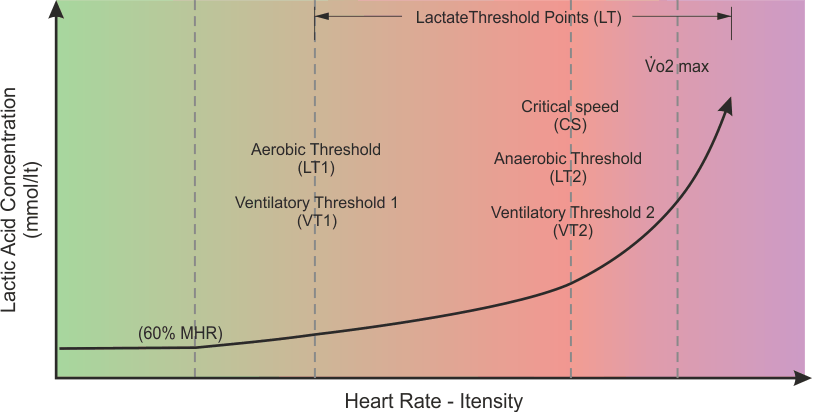
Major variables for designing a training plan are finding the HRs and running paces at our aerobic and anaerobic thresholds respectively, since with these data we will be able to calculate the paces at which the workouts will be performed.
This can be achieved in various ways, as shown below, classifying them by criterion of accuracy of determination:
- The most accurate method is the ergometric test. In addition to the above data, the ergometric test can also provide other very useful information for designing a training plan.
- The second method is with the help of analytical lactic acid and a sports watch. The values we will get, if the procedure is performed correctly, are very close to the real values (https://uphillathlete.com).
- Τρίτη μέθοδος είναι το τέστ Conconi. Οι τιμές που θα πάρουμε και με αυτή την μέθοδο είναι πολύ κοντά στις πραγματικές τιμές, εάν εκτελεστεί η διαδικασία σωστά. (https://www.brianmac.co.uk).
- There are other ways in which we can estimate our HRs and rates at the aerobic and anaerobic threshold, but with a high probability of error. These are:
- The estimation of critical heart rates, therefore, and running paces, from times we have run in 5k and 10k races.
- With sports watch applications.
- By subtracting our age from 220 or better performing the operation [206.9 – (0.67 x age)] to find the MHR, so approximately after the HR of the HR zones, and therefore also the running paces. In determining the threshold HRs with this method, how trained each athlete is and what type of training they have done plays a role in addition to their age. There is a very high probability of error.
With the Conconi test, we can find values very close to the real ones without specialized equipment beyond the sports watch, which most people have. Therefore, we can determine the aerobic and anaerobic thresholds at no cost. The disadvantages are that an assistant is needed to perform the test and great attention is needed when performing and analyzing the results. For these reasons, I consider it a very good choice for someone who has long distance running as a hobby and is willing to delve into endurance running. It is the method that I use and I will analyze in an article that will list the process of performing and calculating the thresholds, in the context of my preparation for a target race that I have set. However, the best choice is undoubtedly the ergometric test.