A goal without a plan is just a wish. (Antoine de Saint Exupery) A goal without a plan is just a wish. (Antoine de Saint Exupery) A goal without a plan is just a wish. (Antoine de Saint Exupery) A goal without a plan is just a wish. (Antoine de Saint Exupery) A goal without a plan is just a wish. (Antoine de Saint Exupery)
A goal without a plan is just a wish. (Antoine de Saint Exupery) A goal without a plan is just a wish. (Antoine de Saint Exupery) A goal without a plan is just a wish. (Antoine de Saint Exupery) A goal without a plan is just a wish. (Antoine de Saint Exupery) A goal without a plan is just a wish. (Antoine de Saint Exupery)
Training Plan for a 10km Race
Before we start designing the training plan, it is very important that it has been defined as precisely as possible. the aerobic and the anaerobic. Based on these values, the running paces at which the workouts will be performed will be calculated.
Aerobic and anaerobic thresholds should be assessed at the beginning of the basic preparation and at the end (the week of unloading and if possible the day of fartlek training), before the special training / pre-competition period. If we have to choose the most appropriate time to do an ergometric test, this is at the end of the basic preparation period and before the special training / pre-competition period. To determine the values of the aerobic and anaerobic thresholds that we will rely on during the basic preparation, one of the other methods of determination is recommended in order of priority for accuracy, so that we do not have to spend money.
The estimated race time depends on the athlete's athletic background, athletic ability and the training time that one can allocate, assuming that the weather conditions on the day of the race will be good. At the end of the page, the running pace times of the training sessions will be calculated and an estimate for a 10k race time will be made by pressing the button «Calculating training paces and race paces».
It is recommended that mandatory trainings be performed after a reasonable recovery time after work to achieve the indicated paces.
Warm-up and cool-down will be performed before and after each interval trainings, tempo trainings or fartlek trainings respectively, but will not be written in the plan for brevity reasons and will be as follows:
The anaerobic threshold pace will be recorded as LT2 (seconds/km).
Aerobic threshold pace will be listed as LT1 (seconds/km).
The subtraction of anaerobic threshold rates from aerobic will be written as SU [SU = LT1 – LT2 (seconds/km)].
Running pace will be recorded as P (seconds/km).
The running time will be listed as X (seconds).
The rest time between the fast runs of a series of runs will be listed as s (seconds).
The rest time between sets of runs will be recorded as ss (seconds).
Training sessions will be performed on routes without inclines.
Within a macrocycle we can run many 10k races, shorter or longer in distance. Most experienced amateur runners have as their main goal race a longer-distance race, for example a half-marathon or marathon road race. For this reason, we will consider the 10k race to be an intermediate goal and not the main goal race of the macrocycle. Therefore, we will consider this specific training plan to be included in a training plan with a primary goal of a half marathon race or marathon race and is located in the time period that coincides with part of the basic preparation period and the special training / pre-competition period of the main goal. We will analyze the special training / pre-competition period, the special training / competition period, the tapering and peaking period and the recovery period, of the 10k race training plan, as part of our preparation for a longer distance goal race of a 12-month long cycle. The period of basic preparation for the 10k race is omitted since we go through the basic preparation of the marathon therefore it is not necessary (basic preparation x intermediate cycles have preceded for the preparation of the main goal). Depending on the time period of the 10k race in relation to the main goal race, some of the periods of the training plan for the 10k race may be omitted or have a shorter duration. In our case we assume that the time of the race of 10k is about halfway through the special training/pre-competition period to have a complete 10k race preparation plan. The preparation period for the 10k race will last 11 weeks.
The microcycle period will be 1 week.
Long distance running workouts will be held on Sunday.
On strength days, we should perform exercises with a load (not many pounds) that allows us to perform the training the next day at the indicated paces (interval training, tempo training). In each set, exercises will be performed for
The color representation of training priority is as follows:
Red: Priority A (mandatory).
Orange: Priority B.
Yellow: Priority C.
[It is estimated that to achieve a time in the 10k race under 34′ (as long as the athlete's athletic abilities allow) (5) five to (7) seven workouts per week are necessary]
The training periodization for the 10k race is shown in the image below.
Training periodization for a 10k race
The training plan for a 10k race is presented in tables 1 to 4, which list the trainings for the basic preparation, the special training/pre-competition period, the special training/competition period, and the transition period, respectively.
To find the running paces of the trainings and breaks, it is enough to perform the indicated operations (at the end of the page the running pace of the trainings are automatically calculated by pressing the button «Calculating training paces and race paces»).
Table 1: Interval trainings, tempo trainings, tempo training and long run tranings of the «Special Training - Pre-Competition Period»
Table 2: Interval trainings, fartlek trainings, tempo trainings and long run tranings of the «Special training - Competition Period»
Table 3: Interval trainings and long run tranings of the «Tapering and and Peaking Period»
Check and select the desired products presented in the tab or in the Anthrax Machines e-shop.
Send details of the selected products (type, number, quantity, name to be printed, shipping details) via the tab «Contact us» writing in the topic «Apparel».
Within 24 hours of submitting the request, an e-mail will be sent confirming receipt of the request and clarifying any questions.
Order processing:
In the event that the order contains products displayed on this tab, it is forwarded directly to the company.
Otherwise, there is communication between the website administrator and Anthrax Machines in order to send the 3D version of the product. It is then forwarded to the interested and if the result satisfies them, the order processing procedures will continue, otherwise there is the possibility of its cancellation.
Forwarding an order form to the buyer and communicating Anthrax Machines' IBAN accounts so that the money can be deposited.
After the deposit of the money, the products are produced and shipped to the customer (the estimated production time of the products of each order is 3 weeks).
Maximum Heart Rate (MHR)
Maximum heart rate is the maximum number of beats per unit of time that the heart can reach during physical activity (at the point of exhaustion).
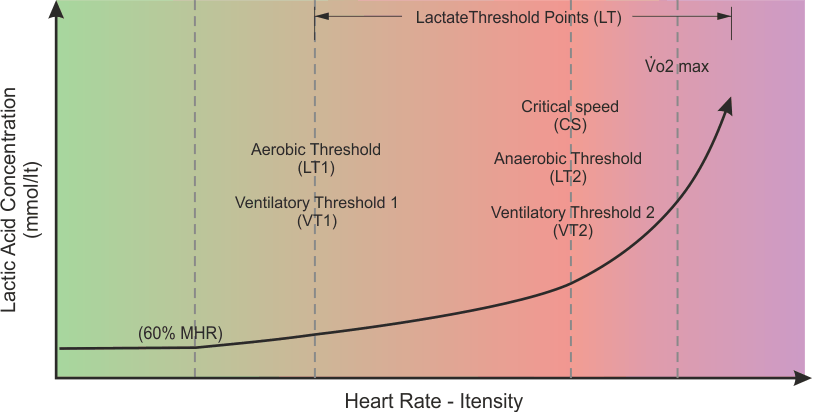
Anaerobic threshold is the intensity of exercise, and therefore the point in heart rate and running pace, at which the production of lactic acid occurs at a greater rate than its removal, and from there on the lactic acid concentration begins to increase significantly (the concentration of lactic acid in the blood). for the majority is about 4mmol/L).
Aerobic threshold is the intensity of exercise and thus the point in heart rate and running pace, at which there is a balance between lactic acid production and its removal (the concentration of lactic acid in the blood for the majority is approximately 1.5 – 2mmol/L). After that point, lactic acid removal occurs at a lower rate than its production.