A goal without a plan is just a wish. (Antoine de Saint Exupery) A goal without a plan is just a wish. (Antoine de Saint Exupery) A goal without a plan is just a wish. (Antoine de Saint Exupery) A goal without a plan is just a wish. (Antoine de Saint Exupery) A goal without a plan is just a wish. (Antoine de Saint Exupery)
A goal without a plan is just a wish. (Antoine de Saint Exupery) A goal without a plan is just a wish. (Antoine de Saint Exupery) A goal without a plan is just a wish. (Antoine de Saint Exupery) A goal without a plan is just a wish. (Antoine de Saint Exupery) A goal without a plan is just a wish. (Antoine de Saint Exupery)
Measuring maximum heart rate (MHR) with the help of a sports watch
It is very important when creating a training plan for a long distance race to know the MΗR of the athlete for whom it will be intended. Based on this, during training we are given the opportunity to work on different loads depending on the adaptations we want to achieve in the body.
In the test to find the maximum heart rate (MHR), the use of a chest heart rate belt is recommended as it provides greater measurement accuracy, compared to the wrist oscilloscope that many sports watches have.
The test to find the MHR should be performed on a route without elevation changes. It should also be at least 2.5km long and there should be no obstacles that could interrupt or disrupt the rhythm of the run during it. Ideally, it should be performed on a track field.
Test execution procedure
10' warm-up, running drills and 4 strides.
The distance, when the test is completed, shouldn't be less than 1600m and greater than 2500m.
The pace for the first 400m is slow, about the pace of the warm-up. After 400m, without stopping the effort, the pace should be increased by 3s for every 200m covered and after 1600m by 2s for every 200m covered. The test ends when it is not possible to increase the pace any further. At that point the body will have reached its MHR. Particular attention should be paid to the pace at which the test begins
10 minutes cool-down and stretching.
From the watch's statistics, we see the MHR that the body has reached during the test.
When the test is finished, the HRV and running paces must be matched to the heart rate zones from the tab «training plan for a 10km race over 45'», so that workouts are performed based on running paces.
Finding Maximum Heart Rate and Heart Rate Zones Given Age
Instructions for processing the order
Check and select the desired products presented in the tab or in the Anthrax Machines e-shop.
Send details of the selected products (type, number, quantity, name to be printed, shipping details) via the tab «Contact us» writing in the topic «Apparel».
Within 24 hours of submitting the request, an e-mail will be sent confirming receipt of the request and clarifying any questions.
Order processing:
In the event that the order contains products displayed on this tab, it is forwarded directly to the company.
Otherwise, there is communication between the website administrator and Anthrax Machines in order to send the 3D version of the product. It is then forwarded to the interested and if the result satisfies them, the order processing procedures will continue, otherwise there is the possibility of its cancellation.
Forwarding an order form to the buyer and communicating Anthrax Machines' IBAN accounts so that the money can be deposited.
After the deposit of the money, the products are produced and shipped to the customer (the estimated production time of the products of each order is 3 weeks).
Maximum Heart Rate (MHR)
Maximum heart rate is the maximum number of beats per unit of time that the heart can reach during physical activity (at the point of exhaustion).
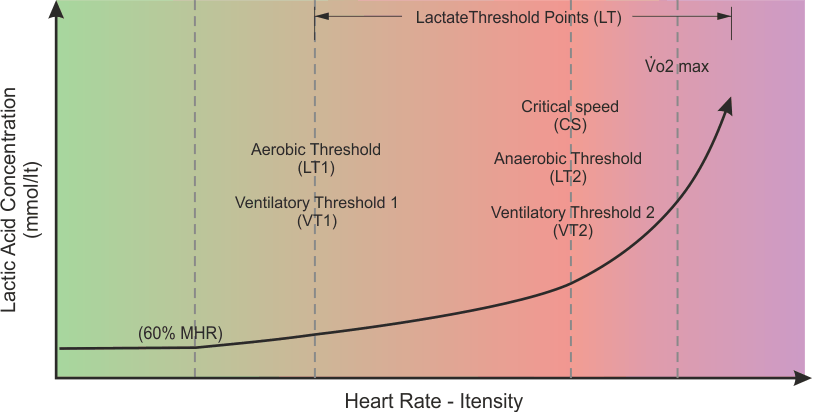
Anaerobic threshold is the intensity of exercise, and therefore the point in heart rate and running pace, at which the production of lactic acid occurs at a greater rate than its removal, and from there on the lactic acid concentration begins to increase significantly (the concentration of lactic acid in the blood). for the majority is about 4mmol/L).
Aerobic threshold is the intensity of exercise and thus the point in heart rate and running pace, at which there is a balance between lactic acid production and its removal (the concentration of lactic acid in the blood for the majority is approximately 1.5 – 2mmol/L). After that point, lactic acid removal occurs at a lower rate than its production.