After seeing how to determine the variables and constants of the equation, it now remains to create it. The result will be the estimated completion time of the target raceAfter seeing how to determine the variables and constants of the equation, it now remains to create it. The result will be the estimated completion time of the target race. For each athlete and each target race the equation differs, but it agrees in a more general framework which we will analyze below.
Purpose of training design
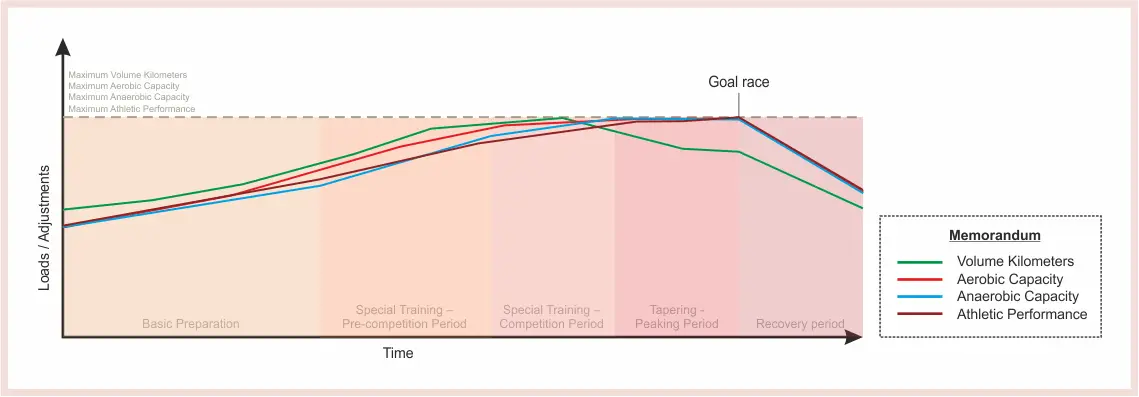
The purpose of training planning is to exploit the results of overload and unloading in our body. With overloading the body tries to cope with the new demands of the cardiopulmonary and musculoskeletal system, resulting in adaptations to it during unloading, thus building its physical condition. Overloading must be done progressively in order to avoid possible injury and over time the increasing work must have a lower rate of increase than at the beginning of the preparation. Recovery is also very important, for this reason recovery training must be performed correctly, sleep must be sufficient and we must eat properly
Periodization
Periodization is the process of dividing a training plan into smaller time intervals with different types of loads. This way we manage to develop different physiological capacities in our body during the different phases of training, taking advantage of the principle of overload and unloading.
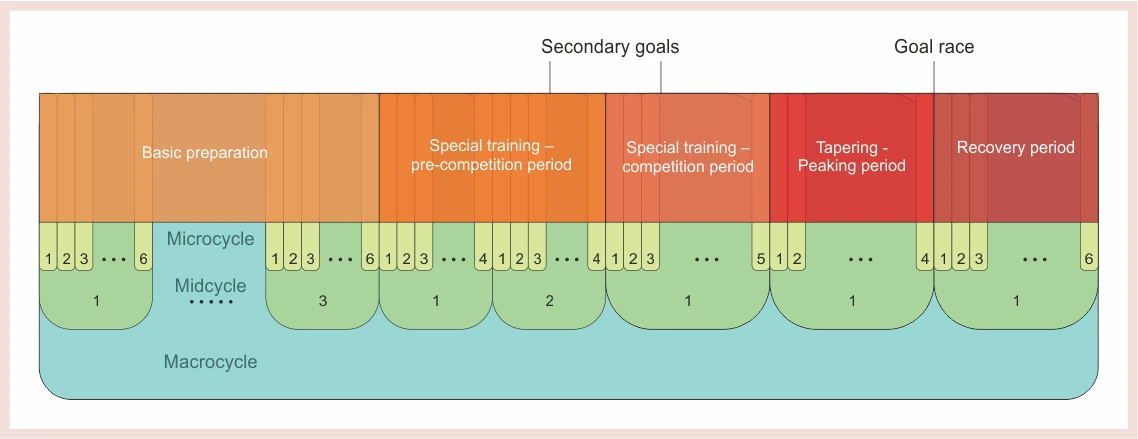
Periodization consists of three time periods “cycles”:
- Macrocycle
- Midcycle
- Microcycle
The Macrocycle is the longest training cycle of the three and usually lasts one year. Within it we can set a long-term goal, which will be the main goal, to culminate in it. However, we are given the opportunity to include intermediate goals in our planning and structure our program so that we culminate in them as well. The macrocycle includes all the training periods of a training plan (basic preparation, special training - pre-competition period, special training - competition period, shaping - peak, transition period - recovery). Each training period consists of 1-3 intermediate cycles.
The Midcycle is a training cycle designed to achieve a specific goal, such as developing strength adaptations, strength endurance, cardiorespiratory fitness, etc. Each mesocycle consists of 3-6 microcycles.
The Microcycle It is the shortest training cycle of the three, which has its own goal and is fully consistent with the focused goal of the mid-cycle it is included in. The duration of the microcycle is from 1 to 2 weeks.
Training periods
In addition to periodization into time cycles, as mentioned above, we must also divide our training plan into training periods. The goal of each training period is to give special emphasis to specific loads (intensities), in order to achieve targeted adaptations in the body. Each training period is also divided into sub-periods/phases. The training periods into which we can divide a training plan are the following:
- Basic preparation (12-18 weeks)
- Loads for developing aerobic adaptations
- Loads to improve anaerobic adaptations (improvement of anaerobic threshold, strength endurance
- Loads – tensions to improve strength
- Loads – intensities to improve speed and power (neuromuscular adaptations)
- Running drills to improve flexibility and coordination
- Special training – pre-competition period (6-8 weeks)
- Increasing loads – intensities to improve aerobic adaptations (improvement of aerobic threshold)
- Increasing loads - intensities to improve anaerobic adaptations (improvement of anaerobic threshold, strength endurance)
- Loads – tensions to maintain strength
- Loads – intensities to improve speed and power (neuromuscular adaptations)
- Running drills to maintain flexibility and coordination
- Special training – competition period (5-6 weeks)
- Increasing loads – intensities to improve aerobic adaptations (improvement of aerobic threshold)
- Increasing loads - intensities to improve anaerobic adaptations (improvement of anaerobic threshold, strength endurance)
- Running drills to maintain flexibility and coordination
- Tapering - Peaking period (3-4 weeks)
- Maintaining aerobic adaptations
- Maintaining anaerobic adaptations
- Running drills to maintain flexibility and coordination
- Mental upliftment for the day of the target race
- Recovery period (4-6 weeks)
- Physical and mental recovery from the stresses of the race and months of preparation