Maximum Heart Rate (MHR)
Maximum heart rate is the maximum number of beats per unit of time that the heart can reach during physical activity (at the point of exhaustion).
Aerobic Metabolism and Anaerobic Metabolism
Cellular metabolism is the process of converting carbohydrates, fats and proteins into energy needed by cells. During cellular metabolic pathways energy is stored in high-energy phosphate bonds of adenosine triphosphate (ATP) molecules, which serves as the energy currency of cells. Depending on the oxygen demand during the production of ATP, there are two types of metabolism in the cell aerobic and anaerobic. Of the three basic metabolic pathways, only the citric acid cycle - Krebs cycle (aerobic system) is considered aerobic metabolism, while the other two which are glycolysis (anaerobic glycolysis system) and energy production from ATP and phosphocreatine (CP) stores as well as the enzymes creatine kinase and myokinase (phosphagon system), are considered anaerobic metabolisms.
Glycolysis
The term glycolysis generally describes the biochemical process of breaking down sugars, and especially glucose, hence its name.
Carbohydrate Metabolism
Carbohydrate (sugar) metabolism occurs during digestion. Carbohydrates are broken down into simple, soluble sugars that can be transported through the intestinal wall into the circulatory system for subsequent transport throughout the body.
Lactic Acid
Lactic acid is an organic acid (C3Η6O3) that is present especially in muscle tissue as a by-product of anaerobic glycolysis. When lactic acid in the muscles has a concentration of 25 – 30 mmol/kg, it prevents the breakdown of glycogen (a polysaccharide, which is formed from long chains of glucose molecules). The acidic environment in muscle cells reduces their ability to bind calcium and as a result, this reduces their contraction.
Lactate threshold – LT
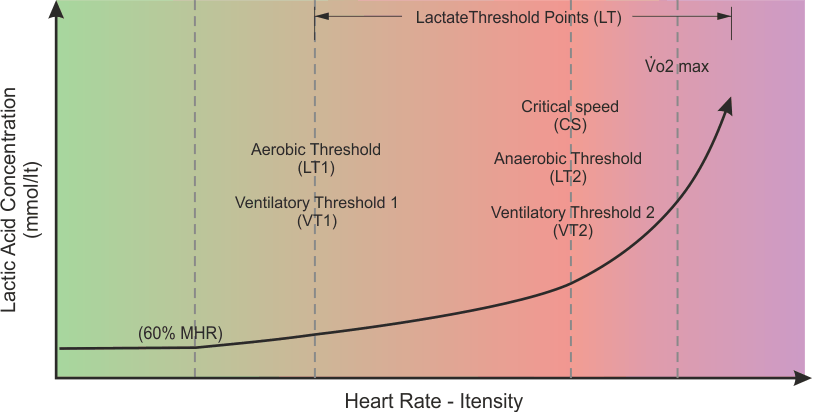
It is the intensity of the exercise, so correspondingly each point, "the area - the range", of the heartbeats where the production of lactic acid is carried out at a greater rate than its removal.
Ventilatory Threshold 1 – VT1
Ventilatory Threshold 1 is the intensity of exercise and therefore the point in heart rate and running pace, at which there is a balance between lactic acid production and its removal. Ventilatory Threshold 1 is measured by analyzing oxygen uptake measurements (the blood lactate concentration at aerobic threshold for the majority is approximately 1.5 – 2mmol/L).
Aerobic Threshold – LT1
Aerobic threshold is the intensity of exercise and thus the point in heart rate and running pace, at which there is a balance between lactic acid production and its removal (the concentration of lactic acid in the blood for the majority is approximately 1.5 – 2mmol/L). After that point, lactic acid removal occurs at a lower rate than its production.
Ventilatory Threshold 2 – VT2
Ventilatory Threshold 2 shows a close relationship with a anaerobic threshold.. Σε εκείνο το σημείο οι αναπνοές γίνονται πολύ έντονες και ο αθλητής μπορεί να κρατήσει την προσπάθεια σε αυτή την ένταση για μεγάλο χρονικό διάστημα. Το αερόβιο κατώφλι μετριέται αναλύοντας τις μετρήσεις της πρόσληψης οξυγόνου (η συγκέντρωση γαλακτικού οξέος στο αίμα για την πλειονότητα είναι περίπου 4mmol/L).
Anaerobic Threshold – LT2
Anaerobic threshold is the intensity of exercise, and therefore the point in heart rate and running pace, at which the production of lactic acid occurs at a greater rate than its removal, and from there on the lactic acid concentration begins to increase significantly (the concentration of lactic acid in the blood). for the majority is about 4mmol/L).
Critical Speed (CS)
Critical speed is the speed that can be maintained in running for a prolonged period of time without excessive lactic acid concentration, while above this the lactic acid concentration begins to increase significantly. Its finding is achieved by timing certain distances, the time to exhaustion at them and correlating them through mathematical operations. Critical speed (CS), anaerobic threshold (LT2) and respiratory threshold 2 (VT2) represent essentially the same physiological limit of exercise intensity with the difference that critical speed is calculated in a non-invasive way.
V̇O2 max
V̇O2 max (maximal oxygen consumption, maximal oxygen uptake, or maximal aerobic capacity) is the maximum rate of oxygen consumption per unit time that can be achieved during physical exercise and is measured in milliliters of oxygen consumed per kilogram of body weight per minute. Maximal oxygen consumption reflects cardiorespiratory fitness and the ability to endure exercise performance. Top distance runners can achieve maximal V̇O2 max values approaching 75 -85 mL/(kg min).
Aerobic Exercise
Aerobic exercise puts our body's muscles into motion, using oxygen. In this way, it burns carbohydrates and fat to produce energy.
Anaerobic Exercise
Anaerobic exercise causes muscles to move without requiring oxygen, burning mainly carbohydrates to produce energy.
Running Economy
Running economy is the oxygen consumption while running at a specific speed and is usually expressed in milliliters of oxygen consumed per kilogram of body weight per minute (ml/kg/min).
Interval
Interval training is described as training that includes periods of intense effort (75%-90% of MHR) alternating with rest breaks or, better yet, active recovery breaks, i.e., much milder effort, during which the body rests to continue the activity.
Fartlek
Fartlek training (Swedish for "speed play") is described as a continuous run in which periods of faster running (75%-90% of MHR) are mixed with periods of running at an easy or moderate pace (65%-75% of MHR) rather than complete rest as with interval training.
Long Run
Long-duration training or long run is described as the longest run within a microcycle.
Tempo Run
Tempo training or tempo running is described as an extended run lasting from 20 minutes to 1 hour, perhaps a few minutes longer for very experienced runners, at a specific relatively comfortable fast pace near the anaerobic threshold (75%-90% of MHR).
Easy run
Free running or easy running is described as continuous steady-state running (65%-75% of MHR) of medium or long duration (30 to 90 minutes).
Recovery Run
A recovery run is described as a prolonged low-intensity run (50%-65% of MHR) to relieve the body and is usually performed within 24 hours of a high-intensity workout.
Stride
Stride is an 80-100m run, usually accelerated, at a pace considerably faster than the warm-up, but not so fast as to cause fatigue.
Active Stretching
Active stretches are the deliberate contractions of the muscles we are trying to stretch.
Running Drills
Running drills are dynamic running exercises that help with muscular assimilation of movement patterns.