A goal without a plan is just a wish. (Antoine de Saint Exupery) A goal without a plan is just a wish. (Antoine de Saint Exupery) A goal without a plan is just a wish. (Antoine de Saint Exupery) A goal without a plan is just a wish. (Antoine de Saint Exupery) A goal without a plan is just a wish. (Antoine de Saint Exupery)
A goal without a plan is just a wish. (Antoine de Saint Exupery) A goal without a plan is just a wish. (Antoine de Saint Exupery) A goal without a plan is just a wish. (Antoine de Saint Exupery) A goal without a plan is just a wish. (Antoine de Saint Exupery) A goal without a plan is just a wish. (Antoine de Saint Exupery)
When designing a training plan for a long distance race, does age and gender play a role, since I know the aerobic (LT1) and anaerobic threshold (LT2)?
When designing a training plan and determining the pace of individual workouts, I believe that age and gender do not play a role. What does play a role is biological age, athletic abilities and how much someone is trained, so what adaptations their body has to long-distance running. These are reflected in the values of aerobic and anaerobic threshold .
In long distance races, where explosiveness and muscle elasticity are of secondary importance, since we are talking about amateur runners, it is much easier to create a training formula that interests a large portion of athletes. To personalize the training plan, the elements needed are the running pace at the aerobic and anaerobic threshold.
So I created some training plans for different endurance races that all athletes can rely on and the running paces of the workouts will be adapted to each one. Knowing the aerobic and anaerobic threshold paces, there is the possibility of individualizing the workouts to a satisfactory degree by solving simple mathematical operations.
In addition to running paces, running drills and stride are especially important in preparing for a race. They are a way to improve or maintain the speed and elasticity of a runner's muscles. This plays a greater role as the paces get faster.
Finding Maximum Heart Rate and Heart Rate Zones Given Age
Instructions for processing the order
Check and select the desired products presented in the tab or in the Anthrax Machines e-shop.
Send details of the selected products (type, number, quantity, name to be printed, shipping details) via the tab «Contact us» writing in the topic «Apparel».
Within 24 hours of submitting the request, an e-mail will be sent confirming receipt of the request and clarifying any questions.
Order processing:
In the event that the order contains products displayed on this tab, it is forwarded directly to the company.
Otherwise, there is communication between the website administrator and Anthrax Machines in order to send the 3D version of the product. It is then forwarded to the interested and if the result satisfies them, the order processing procedures will continue, otherwise there is the possibility of its cancellation.
Forwarding an order form to the buyer and communicating Anthrax Machines' IBAN accounts so that the money can be deposited.
After the deposit of the money, the products are produced and shipped to the customer (the estimated production time of the products of each order is 3 weeks).
Maximum Heart Rate (MHR)
Maximum heart rate is the maximum number of beats per unit of time that the heart can reach during physical activity (at the point of exhaustion).
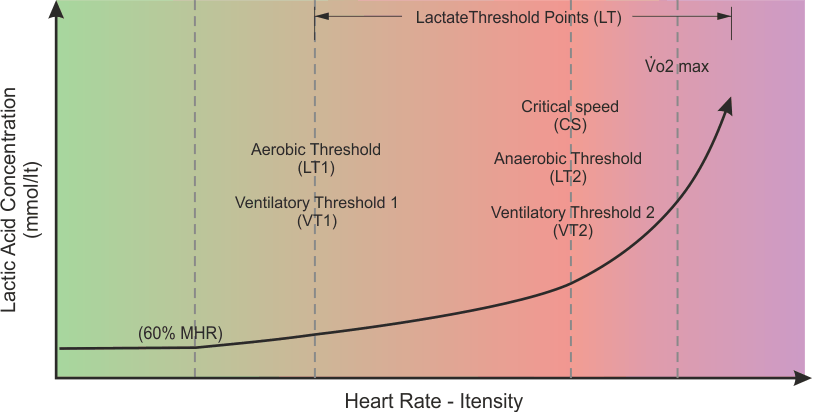
Anaerobic threshold is the intensity of exercise, and therefore the point in heart rate and running pace, at which the production of lactic acid occurs at a greater rate than its removal, and from there on the lactic acid concentration begins to increase significantly (the concentration of lactic acid in the blood). for the majority is about 4mmol/L).
Aerobic threshold is the intensity of exercise and thus the point in heart rate and running pace, at which there is a balance between lactic acid production and its removal (the concentration of lactic acid in the blood for the majority is approximately 1.5 – 2mmol/L). After that point, lactic acid removal occurs at a lower rate than its production.